
Migrating to a new country is not as easy as pie.
Relocating to a new country can be exciting, stressful and overwhelming. It demands thorough research, planning and preparation.
For most migrants, their home country was all they have ever known since birth and therefore the journey of migration is tremendously challenging.
So why would one move from your country of birth to another country?
The decision to relocate usually involves a combination of PUSH and PULL factors.
PUSH factors could be lack of jobs or career opportunities, poverty, violence, poor medical system, political instability or absence of good educational institutions in one’s home country.
PULL factors which attract one to a new country could be job opportunities, being safe from crime and violence, better living conditions, access to natural resources, religious freedom, political stability as well as to health care and public services.
But NO amount of research and preparation fully equips an individual, couple or family for the migration journey.
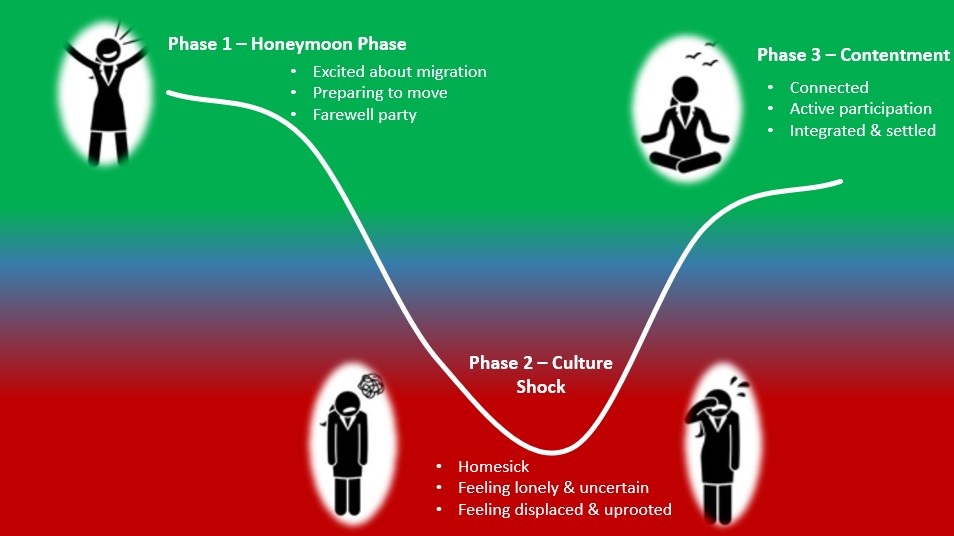
There are 3 phases to settling into a new country:
Phase 1 – Honeymoon phase: excited about the move to a new life and new country and focused on preparing the family for the move. This could involve resigning from the current role, shipping/storing or selling belongings, relinquishing assets and policies, arranging a farewell party with friends and family and applying for the relevant visas.
Phase 2 – Culture shock phase: migrants have arrived in the new country, have moved into their new rental home, commenced working and the children have been enrolled at the local schools. Migrants begin to feel homesick, feeling lonely and uncertain, questioning whether the right decision was made to migrate. Relationships are challenged as the rules of the game are different. Some migrants enter into a dark place, experience depression, grief, loss and at times an identity crisis. Individuals/couples yearn for the way things were, as their past life is all they have ever known. Other migrants feel displaced and uprooted from their home country and lost in the new country with its unique and different culture and customs.
Phase 3 – Contentment phase: migrants have adjusted to their new home, its language, culture and customs. Migrants have integrated into the country and enjoy the opportunities their new home country offers. Friendships and deep connections with others have been made and active participation in social activities are enjoyed. Children have settled well in the schools.
Researchers call it the 3-phased process the “Settlement Curve”.
If you are currently in Phase 1, keen to migrate to New Zealand and require the services of a professional reliable Licensed Immigration Adviser, pls check out our Website at https://aucklandimmigrationservices.com/
or email laetetia@aklimmigration.co.nz
If you are in Phase 2 and need assistance from a qualified NZ Life Coach, pls email me at silverforestnz@gmail.com
If you are in Phase 3 and are frustrated or dissatisfied with your current employment situation and you are considering a change in career, you are welcome to contact me at silverforestnz@gmail.com

0 comments